Bavaria’s oldest ship. The logboat from Lake Constance
Pfahlbaumuseum Unteruhldingen
Strandpromenade 6 88690 Uhldingen-Mühlhofen
Bavaria’s oldest boat. The logboat from Lake Constance
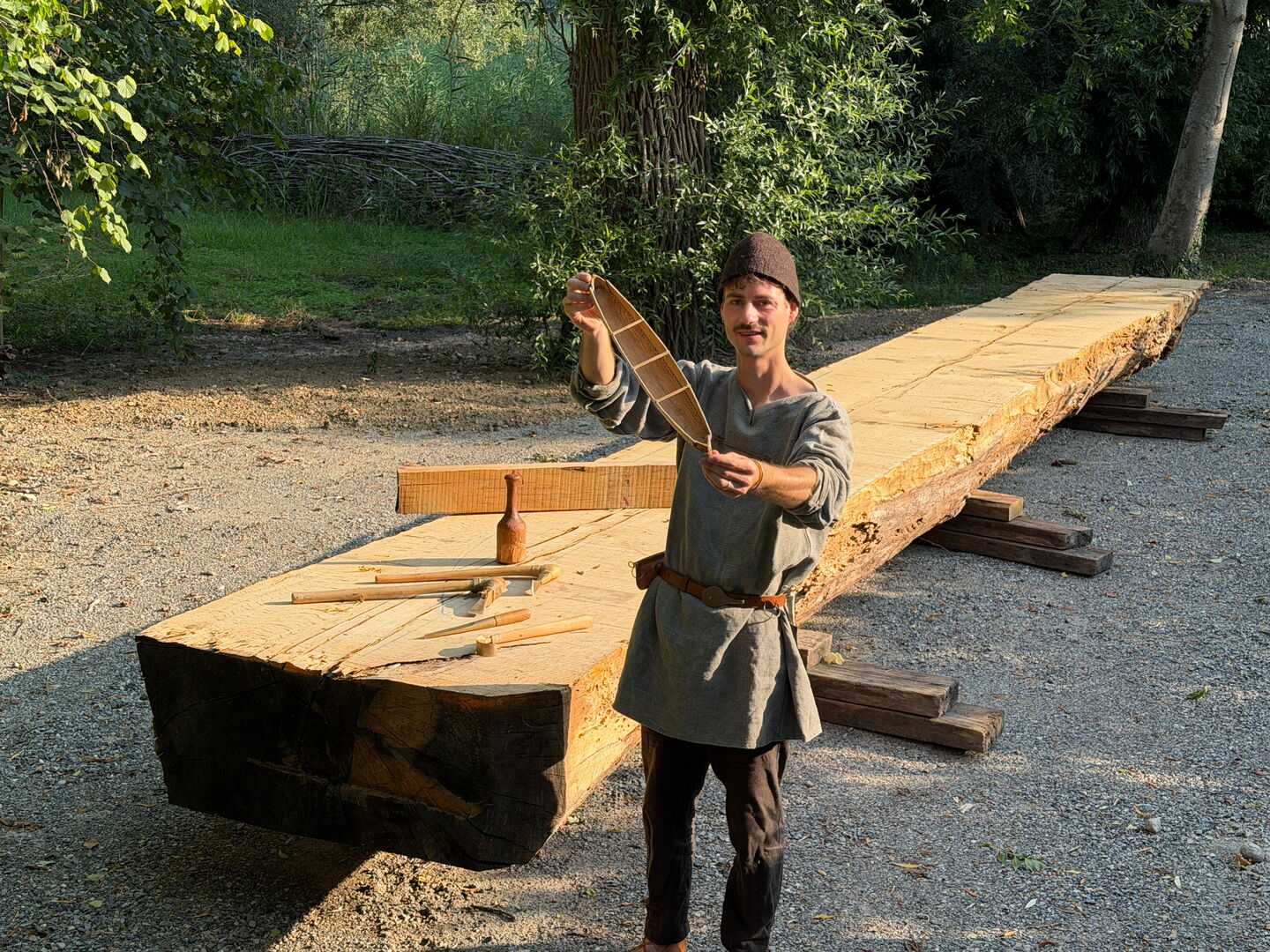
This unique boat is to be reconstructed at the Pile-Dwelling Museum in accordance with the original design and supplemented, so as to provide a better understanding of boatbuilding around 3,000 years ago. To this end, experimental archaeologists Wolfgang Lobisser and Erik Häußler are launching a project on the museum grounds from 10 to 14 August.
In 2018, off the coast of Wasserburg on Lake Constance, the Bavarian Society for Underwater Archaeology, acting on behalf of the State Office for the Preservation of Historical Monuments, recovered a massive, 7-metre-long section of a Bronze Age ship in a sensational operation. Dendrochronological dating placed it around 1137 BC, which archaeologically corresponds to the early Urnfield period. To provide a point of comparison, this was the period of the New Kingdom in Egypt and the year of the death of Pharaoh Ramses VI.
The section of a wooden log from a more than 200-year-old oak tree – initially referred to as a dugout canoe – has since been meticulously conserved at the Munich State Archaeological Collection following its recovery and, once removed from the conservation bath, is to be exhibited in its original form to the public at the museum.
Accompanying wood-anatomical analyses carried out by the Heritage Conservation Laboratory in Thierhaupten near Augsburg and the Pile-Dwelling Museum in Unteruhldingen on Lake Constance showed that the fragment must once have belonged to a larger boat at least 10 metres long, with a diameter of around 110 cm and a side height of at least 40–50 cm. The stern section is missing. A mouth-like opening at the bow, a rectangular opening in the boat’s floor and so-called blind holes in the preserved sidewall suggest that long planks were attached to the sides to raise the freeboard. Such constructions are known archaeologically from similar vessels found in Italy or in the North Sea off Dover in Great Britain. A large number of simpler logboats have already been excavated at Lake Federsee and Lake Constance as means of transport from the Stone and Bronze Ages. However, they differ from this particular specimen in terms of their simpler construction and shape, and were probably only suitable for use near the shore.
At the Research Institute of the Unteruhldingen Pile-Dwelling Museum, an initial reconstruction proposal for an experimental replica was developed, drawing on ethnological and archaeological comparative examples as well as further evidence regarding structural elements from pile-dwelling settlements. Specialists from the departments of Prehistory and Early History at the Universities of Vienna, Munich and Tübingen, as well as the EXAR Association for Experimental Archaeology in Europe, were involved.
As a first attempt, the Bavarian vessel is to be reconstructed as a pirogue. This is a type of vessel known throughout the world, in which the side walls of a keel are raised using simple planks to make the craft more seaworthy. Attempts to cross Lake Constance over long distances in rough seas using simple logboats have so far failed miserably in every case due to the low freeboard. Whether the Uhldingen experiment to replicate the Bronze Age vessel will succeed, and whether the boat will be usable in all weathers, will be revealed by the experimental reconstructions once they are complete – according to museum director Prof. Dr Gunter Schöbel of the University of Tübingen. The project is partly funded by the UNESCO World Heritage Fund of Baden-Württemberg.
Back to the event overview(2026)